Showing posts with label Blood Ban. Show all posts

Saturday, April 12, 2008

If Thailand can accept Gay Blood Donors, Why Can't Ireland?


Its been awhile since I've been on my hobby horse about the Gay Blood Ban, but I ofund this via the Gay News Blog the story is from the Advocate and is about the situation now in Thailand.

On Friday, the Red Cross of Thailand, announced that Gay men will be allowed to give blood! In fact the head of the Red Cross went on to apologies for the ban!

"We didn't mean to hurt anyone," Soisaang Pikulsod, director of the Thai Red Cross National Blood Center, said in the article. "It was just to ensure the highest possible safety of our patients."


The Red Cross in Thailand is now redoing their form and instead of asking about sexual orientation will be asking about high risk sexual behaviour and Drug Use. Now why can't the IBTS do this? This what we are calling for.

If Thailand Can Do It? Why Can't Ireland

Saturday, February 17, 2007

Blood Ban Bebo!


Further from my last post on the blood ban, Steven Conlon, USI LGBTRO, has set up a bebo profile on the blood ban campaign. I think its an excellent idea to get the message out to Irish students as they make up a huge number of users on bebo! So add it as your friend and try and make it on the 1st of March at TCD front square!

Blood Ban Protest March 1st!


From the USI LGBT Website

We will be assembling from 12.30pm on Thursday March 1st, in the Front Square of Trinity College Dublin, and then, - route subject to Garda clearance, - marching to the Department of Health on Hawkin’s Street. There will be a short demonstration there, with one or two guest speakers, and there will then begin a 24-hour vigil outside the department.

!!COME OUT AND SHOW YOUR SUPPORT DURING LUNCH!!


Giving blood is seen as a civic duty in many countries as it allows many life-saving operations to take place. But imagine your are not allowed to give blood, not because you are a IV drug user or engaged in unsafe sex, but for the simple fact you are Gay.

This is highly discriminatory and has been continually opposed by USI LGBT

What is disgusting and homophobic about this is the assumption that ALL gay and bisexual men behave the same sexually. So if you are a gay or bisexual man who has been with the same partner for 30 years, if you always practice safer sex, if you have a certificate to say you are HIV negative, it doesn't matter because in the eyes of the so called medical experts you are a risk factor.

Demonstrate against Ireland's most Discriminatory Club!

Some slogans I got from Facebook:

Donation not Discriminaton
I Was Told I COULDN'T Save a Life Today!
Stop the Hate: Let Gays Donate!
I'm Pissed Because I Can't Give Blood

Red is the colour of the event so wear it with Pride!

Saturday, October 14, 2006

Blood Ban


Okay most of ye may have seen the article I posted here at (http://www.gaywaterford.com/forum/showthread.php?t=602) by Dr. William Murphy, the National Medical Director of the Irish Blood Transfusion Service (IBTS). I have given blood once before I came out in University College Cork and I carry a donor card, but since I came out all I can do is carry the donor card. Therefore, the health service will not take my blood but their willing to take my organs. That is a bit strange.

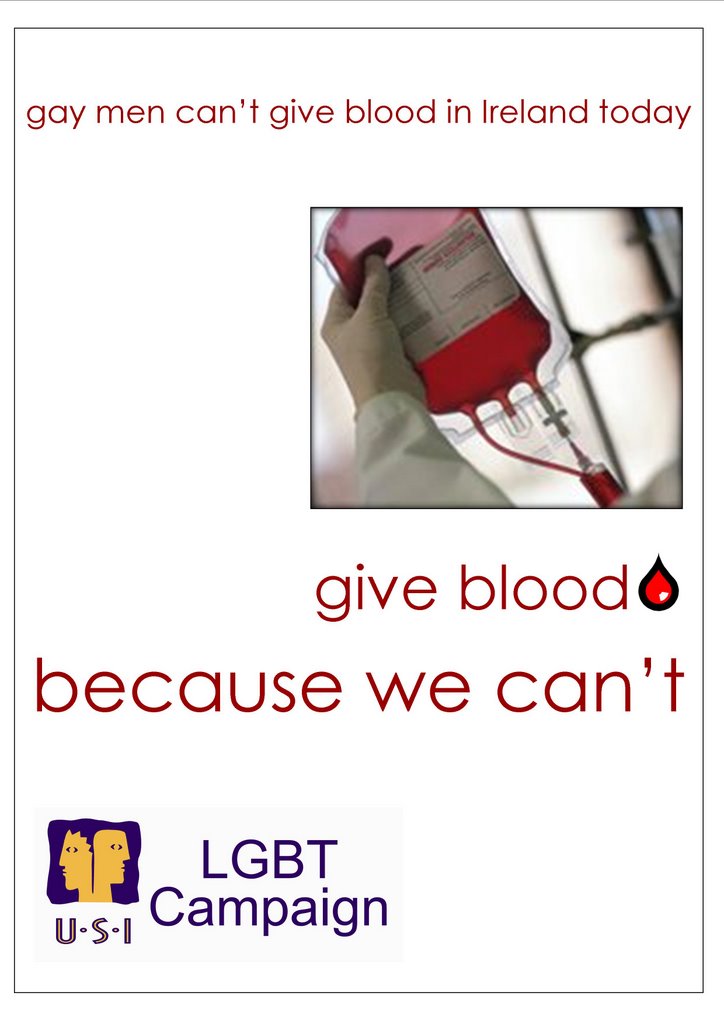
The Union of Students of Ireland, Lesbian, Gay, Bisexual, and Transgendered (USI LGBT) Campaign has been protesting against this ban for a long time. By organising protests at college’s where blood drives are occurring, lobbying and posters (Picture right)

Around the globe national blood transfusion services are gradually moving away from a lifetime ban on homosexual men. In the US gay men who have been celibate since 1979 can give blood and in other countries those who have not engaged in high risk sexual activities from one year to five years previously can give blood.

The IBTS admits it is been discriminatory towards men who have sex with men, but also claim that is discriminatory towards other groups; IV drug users and those who lived in England or Northern Ireland between 1980 to 1996.

The IBTS main reasoning for continuing the ban on men who have sex with men is that as HIV entered the blood supply mainly through Gay and Bisexual men that new infections will enter the blood supply the same way.

Dr. Murphy correctly points out that vCJD (food borne infection) and SARS (airborne infection) are the newest disease to affect humans. The chances of another infection entering the blood supply through gay and bisexual men are slim.

The IBTS admit they are discriminatory but then is outright homophobic on its reasons for not dropping the ban on men who have sex with men. When will they change? Only through lobbying of the IBTS and Minister of Health can we get the IBTS to change its policy towards gay and bisexual men. So get writing to your local T.D.’s, Senators and the IBTS to get this policy changed.

Thursday, September 14, 2006

Ban on gay blood donors did work by reducing disease but now is time for change

Refusing blood donations from homosexual men is discriminatory, but there are developments which may lead to changes, writes Dr William Murphy.

The Irish Blood Transfusion Service, in common with the majority of transfusion services worldwide, causes serious offence to many people, not all of them homosexuals, by its policy of refusing to accept blood donations from men who have ever, even once, had sex with another male.

The policy is blatantly discriminatory on grounds of gender preference and it diminishes men who have sex with men by preventing them from full participation in the community.

Men who are excluded on these grounds would otherwise make excellent blood donors, while many others refuse to support the BTS in protest against its discriminatory policy.

So what brought this state of affairs into existence and why does it persist? When Aids first began to appear among people who had received blood transfusions, in the early 80s, there was no test for the virus; it was known however that there was an epidemic of Aids among gay men.

As an emergency measure, gay men were barred from donating blood. It worked: by the time a test for the virus appeared, the rate of transmission by blood donation had already fallen precipitously and thousands of lives had been saved.

Transfusion services worldwide followed suit. Other groups with high rates of HIV infectivity were also systematically excluded as were other categories of higher- than-average risk for transmitting other infections.

For example, in Ireland, people who have spent more than 12 months cumulatively in Britain or Northern Ireland between 1980 and 1996 cannot donate because of fears they may be more likely to spread vCJD through transfusions.

These policies cannot of themselves render the blood supply free from infection, but they provide some partial defence, and the supply may be less safe without them. Whether homosexual men are a continuing risk for transfusion-transmissible infections can be addressed in the context of risks from known diseases and risks from new, more or less unknown diseases.

Infections with sexually transmissible diseases are more common in homosexual men than in others. They may not comprise the majority of such infections in the community or the only identifiable category of higher-than- average risk in the community, but they form a recognisable category of higher-than-average risk, insofar as they form a category at all.

So do other groups and, where they can be recognised, transfusion services exclude them too.

However only a small minority of homosexual men are at risk; the notion that all gay men are uniformly at risk is as offensive as a similar statement would be for exclusively heterosexual men.

The transfusion services have good tests for HIV and other infections, so the chances of missing an infectious donor are small. However these chances are real - there is a time lag between a donor being infected with a virus and the tests on the donor's blood becoming positive for that virus.

The time lag varies between one to two weeks for HIV to a month or more for hepatitis C. Any person or group of persons with higher rates of disease increase the chances that new infection will be missed because of this.

Transfusion services argue that homosexual men caused rapid dissemination of a new disease through blood transfusion in the past, therefore could do so again.

This argument does have scientific validity from the point of view of risk- management in complex systems, but it is impossible to measure its value in numerical terms.

However, the latest threat posed by an emerging disease - vCJD - was from a food-borne source and others, such as Sars and malaria, have nothing to do with sexual transmission.

The transfusion services argue that accepting homosexual men as donors will not make transfusion safer, but may make it less safe.

While this may be generally true, it is not universally so; any regular blood donor in a stable partnership is safer than one who is not, all other things being equal.

It is often pointed out that the transfusion services do not exclude promiscuous heterosexuals or even heterosexuals who have had a recent new partner, common associations with new cases of sexually transmitted disease.

In other words the transfusion services are inconsistent, open to the charge of unfair bias against homosexuals and unreasonable in their categorisation of homosexual men as homogeneous, promiscuous and unreliable.

Transfusion services worldwide are scarred by their previous mishandling of emerging diseases, and are, understandably, extremely cautious about moving from one fairly secure position to another, perhaps less secure one.

This is particularly the case in this situation, where the beneficiaries of the proposed change are not patients, but others who are not directly dependent on the transfusion services for their well-being. Nevertheless it would be a far better position for human and societal reasons if the transfusion services were to remove the ban on homosexual men.

There are some prospects for this. Several groups are working on methods to remove possible infectious agents from blood transfusions by chemical treatment. If such a process becomes available, any rationale for excluding homosexual men will have disappeared.

A number of countries limit the ban to a period between six months and five years. The experience of these services may inform the future policies of the others.

In the meantime, it behoves the transfusion services to acknowledge and attempt to limit the offence caused, to try to attenuate the collateral damage and to do their best to move forward cautiously and safely as developments in technology and emerging experiences allow.

Dr William Murphy is national medical director of the Irish Blood Transfusion Service

Tuesday, February 28, 2006

Irish Times Article

Blood donor ban on homosexuals opposed

Michael O'Regan

A motion calling on the Irish Blood Transfusion Service to reverse its policy excluding sexually active homosexual men from donating blood was passed by a majority of one at the Young Fine Gael conference.

Young Fine Gael president Patrick O'Driscoll strongly backed the motion, questioning why monogamous gay couples in long-term stable relationships were barred from donating blood, while heterosexuals who engaged in unsafe sex were not subject to the same lifetime ban.

"There was a need for the ban 20 years ago, because of the Aids epidemic. Nowadays, the gay community is probably more sexually aware of health issues than the straight community."

Opposing the motion, Stephen Spillane, vice-chairman of the UCC branch, said that it had been badly worded.

"It specified that it was about sexually active homosexual men. This omitted bisexual men and others. The ban has not been lifted totally in any part of the world. It has been relaxed in some places.

"The fact is that homosexual men engaging in sexual activities are the highest risk from HIV transmission," he added. "The ban is a good idea, but I accept that a lifetime ban is wrong."

Generally, the mood among delegates was upbeat and optimistic, with considerable praise for the manner in which Enda Kenny has restored the party's fortunes.

Conor Cresham, who described himself as a "die-hard Blueshirt from the Mayo Fine Gael capital, Castlebar, Co Mayo", said the mood was very positive at Young Fine Gael meetings. He expressed doubts about sharing power with the PDs.

"I think Michael McDowell said what he said because he wants to be in power. The PDs do not want to be out of office, they will do anything to retain power. The PDs are part of the Government and therefore part of the problem."

Limerick-based student Barry Walsh said party morale had increased significantly. "Membership of Young Fine Gael has rocketed. It is over 4,000 now. When I joined after the last election, it was considerably less than that."

© The Irish Times

Monday, February 27, 2006

Irish youth oppose gay blood donor ban

27-Feb-2006
Marc Shoffman

An influential Irish youth organisation is calling on the country’s blood service to reverse its policy excluding male gay donors.

The Yong Fine Gael conference in Co. Tipperary, Ireland, passed a motion opposing the Irish Blood Transfusion Service’s stance on banning sexually active homosexual men from donating blood.

Group president Patrick O'Driscoll raised the question of why monogamous gay couples in long-term stable relationships were barred from donating blood, while heterosexuals who engaged in unsafe sex were not subject to the same lifetime ban.

He told the Irish Times, "There was a need for the ban 20 years ago, because of the Aids epidemic. Nowadays, the gay community is probably more sexually aware of health issues than the straight community."

However, a member against the motion, Stephen Spillane said: "It specified that it was about sexually active homosexual men. This omitted bisexual men and others. The ban has not been lifted totally in any part of the world. It has been relaxed in some places.”

"The fact is that homosexual men engaging in sexual activities are the highest risk from HIV transmission, the ban is a good idea, but I accept that a lifetime ban is wrong."


Source

I also got quoted in The Irish Times

Tuesday, December 06, 2005

Give Blood because we cant


On the 6th of December, the Irish Blood Transfusion Service will come to UCC for its annual blood drive. At this time, LGBT students and the Students Union, using recently outed and former poster boy of the IBTS, Westlife member Mark Feehily as their own poster boy, will begin an awareness campaign to draw attention to their outdated and discriminatory policy of refusing blood from gay men. The campaign is a peaceful one and does not want to interfere with the very important business of the IBTS. In fact, it is precisely because of the importance of blood donation that the campaign hopes to change IBTS policy.

The lifetime ban on donation from gay men stems from an emergency policy at the height of the AIDS panic around 1985 when the FDA in America imposed a blanket ban on gay men giving blood. At the time, procedures for screening HIV looked for antibodies for the virus, which could take weeks of months to develop. Policymakers had worried
that during this window, HIV-tainted blood could go through the screening process undetected. Today, there are superior testing procedures so that the window from infection to detection has been cut to 10 days. This means that if blood is donated 10 days after a possibility of infection, there is no reason to refuse the blood. According to the IBTS, they "test every donation received for a number of diseases", including Hep B, HIV and Hep C. Based on this, there is
no reason for a blanket ban on 'men who have ever had sex with men'.

The IBTS tries to excuse their discriminatory policy by pointing out that because a HIV emergency originated from the gay community in the 80's, it is possible that a new, unforeseen disease may emerge in the future by the same route. This argument is clearly flawed: a new disease may emerge from any source, whether or not it has in the past. It is this attitude which is homophobic. The IBTS excludes someone based on their sexuality and because eventually they may be prone to some new, unknown virus. This is highly controversial and not a justifiable discrimination.

"Monogamous gay couples in long-term stable relationships, who are tested regularly and have a history of safe sex are barred from donating blood forever, by stark contrast, and revealing the contradictory values of the IBTS, the same policy allows a single heterosexual to have many partners and who doesn't practice safe sex to donate blood" This awareness campaign is asking the IBTS to re-examine their policy and allow healthy and safe people to donate.


The fact is there is no appropriate reason to refuse the blood of gay men on such blanket terms. LGBT Auditor Diarmuid Angland says "Double standards are at play and the reasons the IBTS gives for this are not in touch with modern day studies". And considering the current blood supply crisis, there can be no justification for needlessly turning away blood like this. The Swedish Prime Minister is now the first world leader to call for a review of the blood ban and we applaud this progressive call to keep in step with the times. Let us not forget that any man need only have had sex with another man once in his whole life for this ban to be effective. So what we are calling for in our campaign is a review of IBTS policy. A cautious measure we would like to suggest is to impose a ban on anyone giving blood a year after engaging in risky behavior. UCC LGBT have produced a document in relation to this matter which is entitled "Give Blood because we Cant", which is also the name of the campaign, if you would like to learn more about this matter they can be contacted on ucclgbt@gmail.com

Gay blood is safe blood and gay people are healthy people. This must be recognized. Lives are in the balance.